
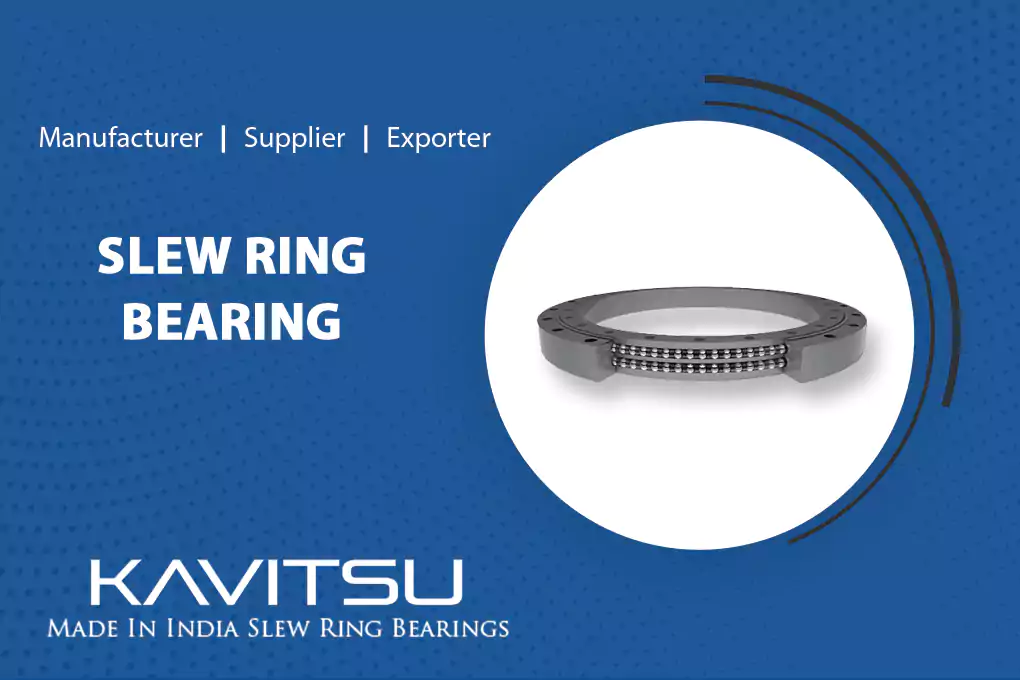
The slewing ring bearing is the most critical rotating component in any crane. It sits between the superstructure (the rotating upper part) and the undercarriage (the fixed base), allowing the crane to swing its boom through 360° while simultaneously supporting enormous axial, radial and tilting moment loads.
Without a properly specified and well-maintained slewing ring bearing, a crane cannot operate safely. This guide covers everything crane engineers, procurement managers and maintenance teams need to know — from bearing types and specifications to failure warning signs and sourcing from India.
Why the Slewing Ring Bearing is the Most Critical Crane Component
Every rotation a crane makes — picking up a load, swinging the boom, placing the load — passes entirely through the slewing ring bearing. At any given moment this single bearing is simultaneously carrying:
- Axial load — the dead weight of the superstructure plus the lifted load
- Radial load — horizontal forces from wind, boom angle and dynamic movement
- Tilting moment load — the overturning force created when a heavy load is held at reach on the boom
This is why crane slewing bearings are large-diameter, heavy-section rings — often 1 metre to 4+ metres in diameter — engineered specifically for combined multi-load conditions that would destroy a standard rolling bearing.
Types of Slewing Ring Bearings Used in Cranes
1. Single-Row Ball Slewing Bearing
Used in lighter cranes — small tower cranes, pick-and-carry cranes, truck-mounted cranes up to around 50 tonnes capacity. The single ring of balls handles combined loads but has lower moment load capacity compared to multi-row designs. Compact and relatively affordable.
2. Double-Row Ball Slewing Bearing
Two rows of balls provide significantly higher load capacity and tilting rigidity. Common in medium-capacity tower cranes, rough terrain cranes and large truck cranes. Offers a better balance of load capacity, compact dimensions and cost than three-row roller designs.
3. Three-Row Roller Slewing Bearing
The heavy-duty choice for large cranes — offshore cranes, heavy-lift crawler cranes, port cranes and large luffing tower cranes. Three separate rows of rollers — one axial upper, one axial lower, one radial — each handle their specific load independently, enabling maximum capacity in the most demanding applications. Bore sizes commonly range from 1.5 m to 4+ m.
Rule of thumb: For cranes up to 50t → Single-row ball. For 50–200t → Double-row ball. For 200t and above or offshore applications → Three-row roller slewing bearing.
Crane Slewing Bearing Specifications – What to Specify
| Parameter | Typical Range for Cranes |
|---|---|
| Bore Diameter | 500 mm – 4,000 mm+ |
| Bearing Type | Single-row ball / Double-row ball / Three-row roller |
| Gear Option | External gear (most common in cranes) / Internal gear / Gearless |
| Material | 42CrMo alloy steel (standard) / 50Mn steel |
| Raceway Hardness | HRC 55–62 (induction hardened) |
| Sealing | Double-lip rubber seal — upper and lower |
| Axial Load Capacity | 500 kN – 50,000 kN (depending on size and type) |
| Standards | ISO, DIN, GB/T |
| Mounting Holes | Custom — matched to crane slew ring bolting pattern |
Tower Crane vs Mobile Crane vs Crawler Crane – Bearing Differences
Tower Cranes
Tower crane slewing rings are typically located at the top of the mast, between the turntable and the mast head. They operate under relatively slow rotation but carry very high tilting moment loads from the jib and counter-jib. External gear bearings are standard, driven by a slew motor and pinion. Most tower cranes use double-row ball or three-row roller designs.
Mobile Cranes (Truck / All-Terrain)
Mobile cranes require compact, high-capacity bearings that can handle rapid slewing and varying load angles. Ball slewing bearings with external gear are most common. Replacement is relatively straightforward compared to tower cranes — the superstructure is removed and the bearing swapped.
Crawler Cranes
Heavy crawler cranes used in infrastructure, energy and industrial projects require the largest slewing ring bearings. Three-row roller designs are standard for machines above 200 tonnes. The bearing must handle full-load slewing across highly varied ground conditions, including uneven terrain.
Offshore / Marine Cranes
Offshore crane slewing bearings face the harshest conditions — salt spray, humidity, dynamic sea movement loads and continuous operation. Stainless steel or specially coated bearings with enhanced sealing are specified. Three-row roller designs are almost universal for offshore lift cranes above 50 tonnes.
Warning Signs of Crane Slewing Bearing Failure
Catching slewing bearing problems early prevents catastrophic failure and costly downtime. Watch for these warning signs:
- Increased gear backlash — if backlash exceeds 1.5× the original specification, bearing wear is significant
- Unusual noise — grinding, clicking or rumbling during slewing indicates raceway or rolling element damage
- Vibration — abnormal vibration during rotation, especially under load
- Visible grease leakage — seal failure allows contamination in and grease out
- Tilting or play — measurable axial or radial play beyond manufacturer limits is a critical alert
- Uneven rotation — stiff spots or jerky movement during the slew cycle
- Rust or corrosion — visible on the gear ring or bearing body, especially in coastal environments
Important: Most crane manufacturers recommend annual slewing bearing inspection by a qualified engineer. Do not wait for audible noise — by that point, internal damage is usually significant.
Slewing Ring Bearing Replacement for Cranes – Sourcing from India
Crane owners and fleet managers increasingly source replacement slewing ring bearings from Indian manufacturers rather than OEM suppliers — for two key reasons: cost and lead time.
European and Japanese OEM replacement bearings typically carry a significant price premium. Indian manufacturers like Kavitsu Robotronix can manufacture a compatible replacement bearing at 20–40% lower cost, with delivery in 4–8 weeks depending on size.
To order a replacement crane slewing bearing from Kavitsu, share the following information:
- Crane make and model (or bearing OEM part number if available)
- Outer diameter, inner diameter, height of the existing bearing
- Gear type — external gear, internal gear or gearless
- Gear module and number of teeth (if geared)
- Bolt hole circle diameter and number of bolts — inner and outer ring
- Application — crane type, lifting capacity, operating environment
Need a Slewing Ring Bearing for Your Crane?
Share your crane make, model or bearing dimensions — our engineers will specify the correct replacement and provide a competitive quote with worldwide delivery.
Send Your Enquiry