
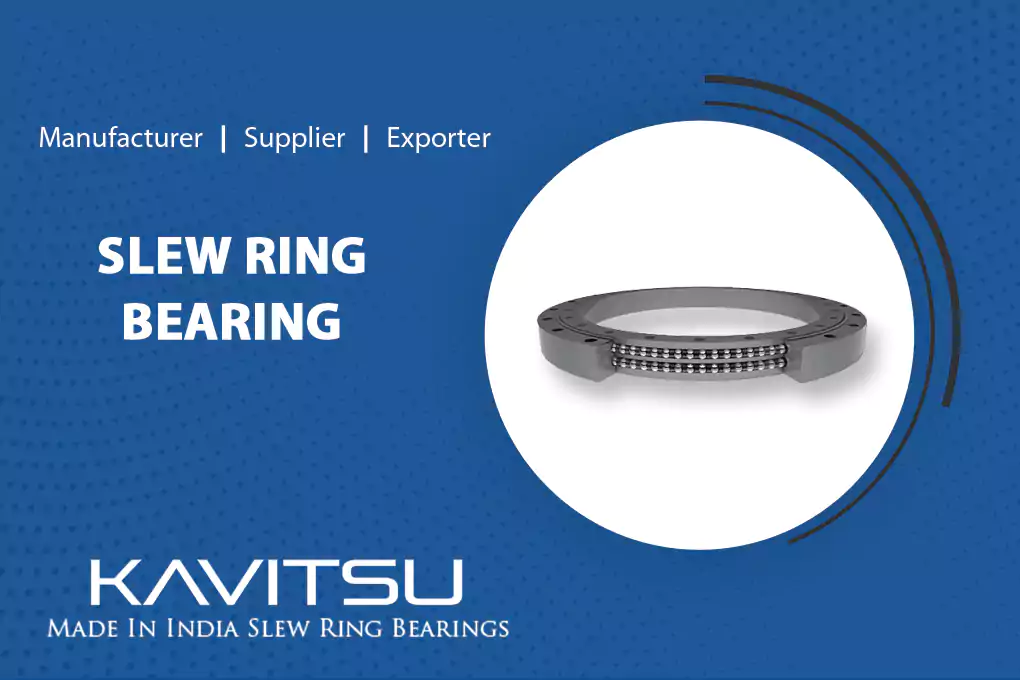
A slewing bearing failure in a crane, excavator, wind turbine or solar tracker is never a minor event. Depending on the machine and application, it can mean days or weeks of downtime, costly replacement, and in worst cases, a serious safety incident.
The good news is that the vast majority of slewing bearing failures are preventable. They don't happen suddenly — they develop over weeks or months and give clear warning signs before they become critical. Understanding why they fail and what to watch for is the most valuable knowledge any maintenance team can have.
This guide covers the 7 most common causes of slewing bearing failure, the early warning signs for each, and proven prevention steps drawn from 30+ years of manufacturing experience at Kavitsu Robotronix.
Important safety note: A slewing bearing supporting a crane, excavator or other load-bearing machine should never be operated when failure signs are present. If you observe any of the warning signs described in this article, cease operation and arrange inspection immediately.
The 7 Most Common Causes of Slewing Bearing Failure
1. Inadequate or Incorrect Lubrication
This is the single most common cause of premature slewing bearing failure — responsible for an estimated 40–50% of all cases. Without a continuous fresh grease film between rolling elements and raceways, metal-to-metal contact generates heat, accelerates wear and leads rapidly to raceway pitting and spalling. Using the wrong grease type, under-lubricating, or lubricating at the wrong intervals all cause the same result. Prevention: Follow the OEM lubrication schedule. Use lithium-complex or polyurea grease with EP additives rated for bearing applications. Apply grease while rotating the bearing slowly to distribute it evenly through 360°.
2. Overloading Beyond Rated Capacity
Operating a machine beyond its rated load — even occasionally — places stresses on the slewing bearing that its raceway geometry and material were not designed to handle. Cyclic overloading causes subsurface fatigue cracking that eventually propagates to the surface as spalling. In cranes this often happens when operators lift loads at reduced radii without accounting for the dramatically increased tilting moment. Prevention: Never exceed rated load charts. Install load monitoring systems on cranes. Ensure operators are trained on the relationship between reach, load and slewing bearing stress.
3. Contamination of the Bearing Interior
Dust, sand, water and metal particles entering the bearing through damaged or degraded seals are highly abrasive. Even fine particles caught between rolling elements and raceways cause rapid surface wear — dramatically shortening bearing life. Offshore and mining environments are particularly high risk. Prevention: Inspect lip seals during every maintenance interval. Replace seals at first sign of cracking or damage. In harsh environments, upgrade to double-lip seals with an additional labyrinth seal. Never pressure-wash directly at the seals.
4. Incorrect Installation
A correctly manufactured slewing bearing can fail within months if installed incorrectly. Common installation errors include: uneven bolt torquing causing bearing distortion, mounting on a non-flat or non-rigid support structure, incorrect preload, and misalignment between the ring gear and pinion. Prevention: Always follow the manufacturer's installation procedure. Use a calibrated torque wrench and tighten mounting bolts in a star pattern. Verify support structure flatness before mounting. Set pinion backlash to specification.
5. Corrosion from Environmental Exposure
Slewing bearings in outdoor, marine or chemically aggressive environments are vulnerable to corrosion — particularly at the gear ring, exposed bolt holes and any area where the protective coating is damaged. Corrosion weakens the bearing structure and provides initiation points for fatigue cracking. Prevention: Apply corrosion-resistant coating to all exposed surfaces. Use marine-grade or stainless steel bearings in offshore applications. Inspect and touch up coating damage promptly. Apply corrosion-inhibiting grease to the gear ring.
6. Raceway Hardening Defects or Material Defects
Not all slewing bearings are manufactured to the same quality. Inadequate raceway hardening depth, inconsistent hardness, or material inclusions in lower-quality bearings result in raceways that cannot sustain the design loads. These failures typically show as early-onset spalling at unpredictable locations. Prevention: Source from reputable manufacturers who provide material certificates and hardness test reports. Specify hardened raceways to HRC 55–62 minimum. Kavitsu provides material and hardness certification on request.
7. Gear Wear from Incorrect Pinion Setup
The gear ring on a slewing bearing drives the rotation via a pinion. If the pinion backlash is set too tight, it causes abnormal tooth contact stress and accelerates gear wear. If set too loose, it causes impact loads on the gear teeth during direction changes. Worn pinion teeth also damage the slewing ring gear over time. Prevention: Set pinion backlash to manufacturer specification (typically 1/10 of the gear module). Replace worn drive pinions promptly — a worn pinion will damage the slewing ring gear even if the bearing is otherwise in good condition.
Early Warning Signs – What to Look and Listen For
- Unusual noise during slewing — grinding, clicking, rumbling or squealing
- Increased gear backlash — measure with a dial gauge and compare to original specification
- Excessive vibration during rotation, especially under load
- Visible grease leakage from the seal area — indicates seal failure
- Stiff spots or jerky rotation at particular points in the slew cycle
- Visible corrosion on the gear ring or bearing body
- Measurable axial or radial play beyond tolerance
- Discolouration of grease (black, metallic particles) on re-greasing
- Elevated bearing temperature during operation
- Visible cracking or spalling on accessible gear teeth
Slewing Bearing Failure Prevention – Maintenance Schedule
The following schedule applies to standard industrial applications. Cranes, offshore equipment and solar trackers operating in harsh environments or under heavy duty cycles should shorten these intervals.
| Interval | Action |
|---|---|
| Weekly | Visual check for grease leakage, abnormal noise, visible damage |
| Monthly | Re-grease bearing (rotate during greasing), inspect seal condition, check bolt torque |
| Quarterly | Measure gear backlash, inspect gear ring teeth, check pinion condition |
| Annually | Full inspection — axial/radial play measurement, NDT inspection of raceways if accessible, coating inspection |
Tip: Keep a maintenance log for every slewing bearing — recording greasing dates, backlash measurements and any observations. This data is invaluable for predicting when replacement will be needed and avoiding unplanned downtime.
Need a Replacement Slewing Bearing?
If inspection reveals damage beyond maintenance recovery, Kavitsu Robotronix manufactures precision replacement slewing bearings to match your existing specifications — with worldwide export.
Request a Replacement Quote